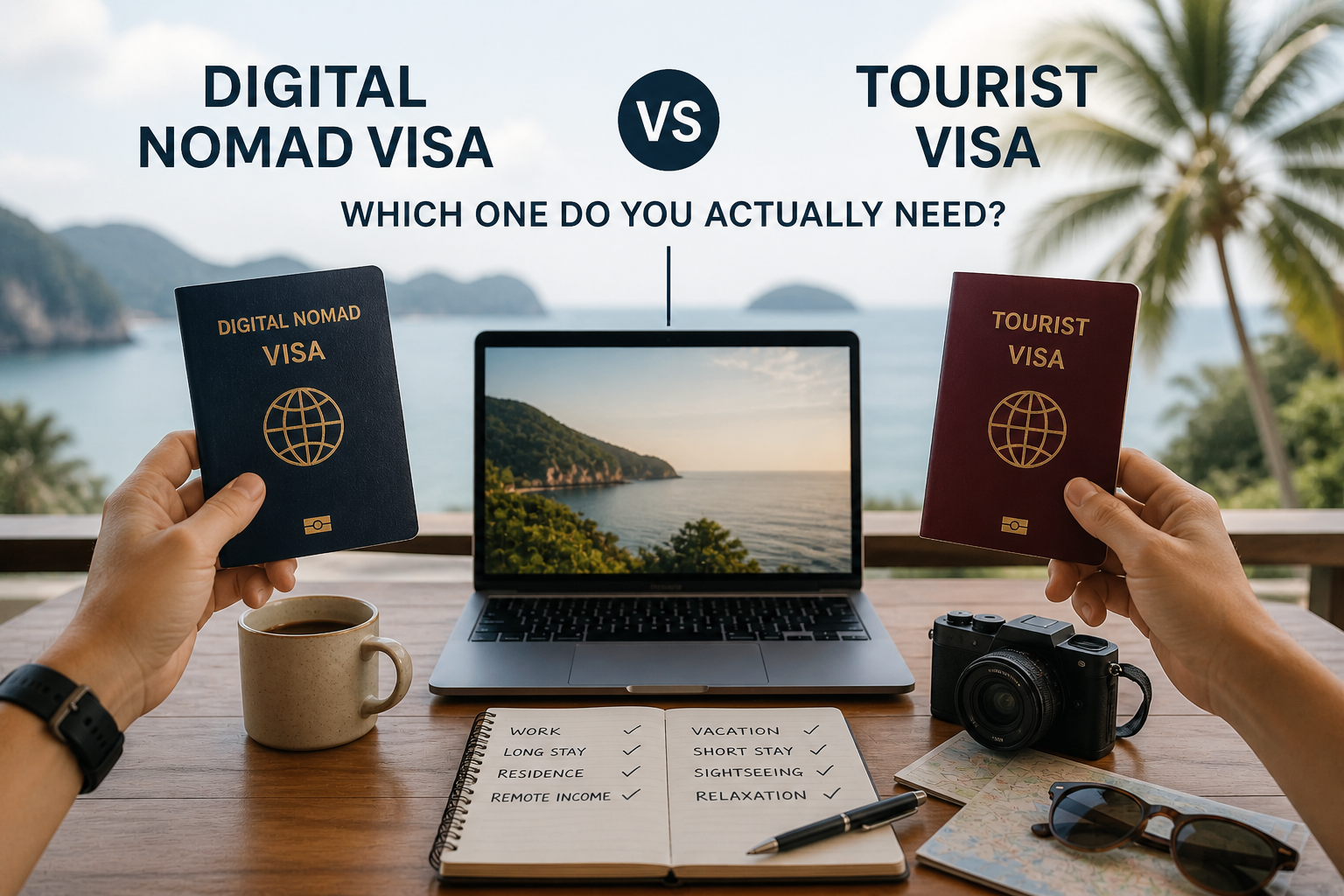
Picture this. You’re working from a cafe in Lisbon. The coffee is strong, the Wi-Fi is fast, and your client calls are done by noon. Life feels perfect until immigration officers walk in and start checking documents. Suddenly, that tourist visa in your passport feels very fragile. This is the reality many remote workers face. The digital nomad visa vs tourist visa question is no longer just a technicality. It is a decision that shapes your legal status, your peace of mind, and your long-term lifestyle abroad. Working as a digital nomad on a tourist visa is a practice that is illegal in almost all countries. Yet millions still do it simply because they don’t know the alternatives.
This guide changes that. Let’s break it down clearly, honestly, and with the current facts you actually need.
The Scale of the Remote Work Shift
Before comparing the two visa types, it helps to understand why this matters so much right now.
Data from Statista published in December 2025 found that in the USA alone, the number of digital nomads in 2024 had increased by a huge 148% compared to 2019. Globally, it is estimated that there are currently between 40 million and 50 million digital nomads earning a living this way.
Governments noticed. Over 65 countries now offer some version of a digital nomad visa. Remote professionals contribute approximately $787 billion annually to the global economy. In response, countries are actively competing to attract this workforce each with their own visa programs, income thresholds, and perks.
The result is a genuine choice between legal pathways. But first, you need to understand what each visa actually means.
What Is a Tourist Visa?
A tourist visa is designed for one purpose: leisure travel. It allows you to enter a country, explore it, and leave. That’s it.
A tourist visa permits short-term travel for leisure or tourism purposes but does not legally allow the visa holder to work during their stay. Most tourist visas last between 30 and 90 days. Some countries offer extensions but working remotely on one remains legally risky almost everywhere.
The problem is not just optics. Many digital nomads use tourist visas, but this is legally risky if the country prohibits working while on a tourist visa. Overstaying or violating terms can result in fines, deportation, or bans.
A single violation can leave a stamp on your passport that complicates international travel for years.
What Is a Digital Nomad Visa?
A digital nomad visa is a purpose-built solution for remote workers. It allows individuals to live and work remotely in a foreign country for an extended period, usually without needing a traditional work permit.
These visas make it possible to stay longer than a tourist visa typically allows, often with the legal right to live, work remotely, and tap into local services for months or even years at a time.
Crucially, they don’t require you to work for a local employer. Instead, you continue working for your existing clients or company abroad. The host country benefits from your spending. You benefit from legal security and a stable base.
You can think of a digital nomad visa as your right to be in a specific country and continue working for yourself or your employer from back home. They don’t grant citizenship or permanent residency, and you must work remotely & you won’t be eligible for local employment.
Digital Nomad Visa vs Tourist Visa: The Key Differences
Here is where the comparison gets practical. These are the six differences that matter most.
- Work Legality – The Most Important Difference
This is the core issue. On a tourist visa, remote work is technically illegal in most countries even if you’re earning money from clients in another country entirely. On a digital nomad visa, remote work is explicitly permitted and legally protected.
In some countries, working remotely on a tourist visa is a grey area, technically any work, even for a foreign company may be against visa conditions. “Grey area” is not the same as safe. If immigration officials decide to enforce the rules, you have no legal footing.
- Duration of Stay
Tourist visas usually come with tight restrictions on how long you can stay often just 30 to 90 days. By contrast, digital nomad visas typically allow stays of 6 to 24 months and often include the option to renew or extend.
For anyone planning to live abroad rather than just visit, this difference alone is decisive.
- Access to Local Services
A digital nomad visa unlocks a layer of practical benefits that tourists simply cannot access. These visas often come with incentives such as tax breaks, access to coworking spaces, and integration into local digital nomad communities.
Furthermore, digital nomad visa holders can tap into local resources such as coworking spaces, banking, and even healthcare. Opening a local bank account, signing a lease, or accessing a local healthcare provider all become far easier with legal residency status.
- Tax Implications
This is where digital nomad visas offer a significant advantage if you choose wisely. Many countries structure their nomad visa programs to exempt foreign-sourced income from local taxation. However, the rules vary considerably between countries.
Whether digital nomads need to pay income tax depends on the country and the individual’s tax resident status. Some countries may not require digital nomads to pay income tax if their income is generated outside the country. However, other countries might have tax treaties or obligations that could require digital nomads to pay local taxes.
Always get tax advice specific to your situation before committing to a long-term stay.
- Family Inclusion
Tourist visas cover only the individual traveller. Many digital nomad programs now accommodate families. The UAE’s virtual working visa allows you to bring several family members for reduced fees. Spain’s digital nomad visa permits spouses, partners, and children under 18 to accompany the primary applicant.
If you’re moving abroad with a partner or children, a digital nomad visa is almost always the only practical option.
- Application Complexity
This is where tourist visas win. They are faster and easier to obtain. Most require no income proof, no employment documentation, and minimal paperwork. Digital nomad visas, by contrast, require more preparation, but that preparation delivers lasting legal protection.
Who Should Choose a Digital Nomad Visa?
A digital nomad visa is the right choice if you plan to stay in one country for more than 90 days, need to work legally during your stay, want access to local services like banking and healthcare, or are travelling with a partner or family.
It is also the smarter long-term investment. The application effort upfront eliminates the ongoing stress of visa runs, border crossings, and legal uncertainty.
Who Might Be Fine with a Tourist Visa?
A tourist visa works if you are genuinely travelling for leisure with no intention to work, your stay will be under 90 days, or you’re scouting a country before committing to a longer-term program.
Even then, be aware: the moment you open a laptop and answer a client email, you may technically be violating your visa terms in many countries. Know the specific rules of wherever you are.
Top Countries Currently Offering Digital Nomad Visas
The list of options continues to grow. Here are some of the strongest programs currently available:
Portugal remains one of the most popular choices. The country offers a stunning Atlantic coastline, a laid-back culture, and a growing network of coworking hubs especially in Lisbon, Porto, and the island of Madeira. After five years of legal stay, digital nomads can apply for permanent residency or citizenship.
Spain offers one of the most comprehensive European packages up to five years, Schengen access, and family inclusion for spouses, partners, and children under 18.
Thailand’s DTV offers 180 days per entry, valid for five years. It targets remote workers, freelancers, and long-stay travellers across Southeast Asia.
Bulgaria launched its digital nomad visa in 2025. The visa allows holders to live and work in Bulgaria for a year with the option to renew for a further 12 months. Sofia and Plovdiv are quickly becoming hubs for remote workers thanks to growing tech scenes and friendly expat communities.
The Philippines introduced its dedicated digital nomad visa in June 2025. The visa gives you a year in the Philippines with the option to extend for a second year and the low cost of living is a significant draw.
Moldova launched its program in September 2025, designed for freelancers, remote employees, and entrepreneurs earning income from outside Moldova, allowing them to live and work legally for up to two years with the possibility of renewal.
What You’ll Need to Apply for a Digital Nomad Visa
Requirements vary between countries. However, most program share these common elements:
Proof of remote employment or freelance income – typically in the form of employment contracts, client invoices, or recent bank statements showing consistent earnings.
Minimum income threshold – these vary widely. Income thresholds range from approximately $3,000 per month in Costa Rica to €4,500 per month in Estonia. Research your target country carefully.
Valid health insurance – covering the full duration of your stay is required by nearly every program.
Clean criminal records – most countries require a background check or police clearance certificate.
Passport validity – typically, your passport must be valid for at least six months beyond your intended stay.
The Real Risk of Getting It Wrong
Let’s be direct. Thousands of remote workers currently operate on tourist visas without incident. However, the risk is not zero and it is growing.
Overstaying or violating visa terms can result in fines, deportation, or bans. Beyond the immediate consequences, a deportation record or entry ban can affect your ability to travel freely for years. Meanwhile, the cost of applying for a legitimate digital nomad visa in most countries is a few hundred dollars and a few weeks of paperwork.
The maths is straightforward. The legal route wins.
How the Digital Nomad Visa Landscape Is Evolving
More governments are now competing for remote workers, not just tourists. South Korea introduced the Workcation Visa in 2024. Mauritius and Cape Verde are attracting nomads with fast-track approvals and no tax on global income.
Digital nomad programs are maturing. More visas now offer 2–5 year stays. Many program now allow dependents or partners. The UAE’s Content Creator Golden Visa and Thailand’s LTR Tech Track are signs of increasing specialization.
The direction is clear. Governments want remote workers. More legitimate pathways will continue to open. The window to establish legal, stable residency abroad has never been wider.
Final Verdict: Digital Nomad Visa vs Tourist Visa
The honest answer is this: for anyone planning to work remotely abroad even occasionally a digital nomad visa is the only legally sound choice.
Tourist visas are not designed for remote work. Using one as a workaround carries real legal risk. Moreover, the growing number of dedicated digital nomad program means that the alternatives are more accessible, more affordable, and more family-friendly than ever before.
Choose the visa that matches the life you’re actually living. Then get on the plane.
Visa regulations change regularly. Always verify current requirements with official government immigration portals or a licensed immigration consultant before applying.





Leave a Reply