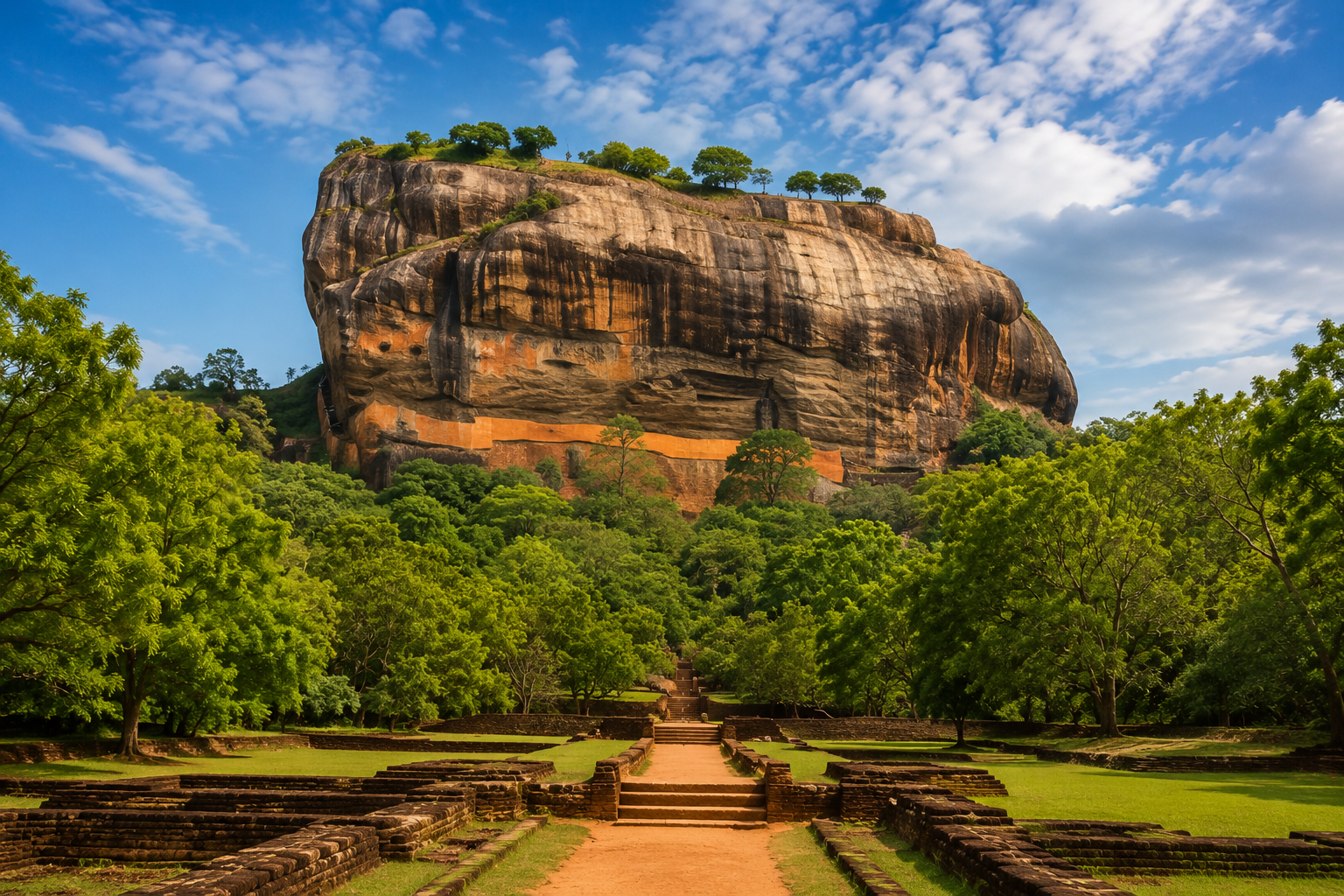
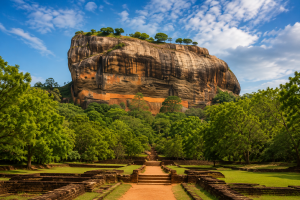
You see it before you are ready for it. A sheer 200 meters wall of dark volcanic rock rising straight out of the flat jungle, crowned with ruins, wrapped in mist. Everything else around it is flat. Sigiriya just appears.
No photograph prepares you for that first sighting of Sigiriya Rock Fortress. The scale is wrong, in the best possible way. It is bigger than you expect, older than feels real, and more beautiful than the pictures suggest. It is the most visited site in Sri Lanka and, many argue, one of the most extraordinary ancient sites anywhere in Asia.
Whether you are planning your first trip or your return visit, this guide covers everything you need to make the most of it.
What Is Sigiriya Rock Fortress?
Sigiriya Rock Fortress is a UNESCO World Heritage Site located in the Matale District of Sri Lanka’s central plains. The rock itself is a volcanic remnant approximately 200 meters tall, rising dramatically from otherwise flat jungle terrain. At its summit sit the ruins of an ancient palace complex built in the 5th century AD.
The site combines geological wonder with extraordinary human achievement. Ancient water gardens, frescoes painted onto sheer rock faces, and a hydraulic system so sophisticated it still partially functions today, all sit within a single complex. It earned the nickname “the Eighth Wonder of the World” and has held UNESCO World Heritage status since 1982.
The Story Behind Lion Rock
The history of Sigiriya reads more like a thriller than a textbook.
King Kashyapa seized the throne of Sri Lanka in 477 AD after imprisoning his own father and forcing his brother Moggallana into exile in India. Knowing his brother would eventually return to reclaim the throne, Kashyapa chose the most defensible location he could find: the top of an enormous volcanic rock.
He transformed Sigiriya into his royal capital. A grand lion shaped gateway welcomed visitors at the base of the final ascent, giving the site its local name, Lion Rock. Symmetrical water gardens, fountains, and an advanced hydraulic system surrounded the base. Artists painted celestial frescoes onto a sheltered pocket of rock face. The Mirror Wall, polished to a reflective shine, displayed royal proclamations.
Kashyapa ruled from Sigiriya for eighteen years. When his brother finally returned with an army, Kashyapa rode out to meet him in battle. He lost. According to historical accounts, he took his own life rather than face capture. After his death, Sigiriya became a Buddhist monastery, a role it maintained until the 14th century. The ruins of that dual identity, royal palace and monastic retreat, are what visitors explore today.
Sigiriya Rock Fortress: Essential Visitor Information
- Opening hours: The ticket office opens at 5:30 AM and closes at 5:00 PM. The frescoes viewing area closes at 5:45 PM. The site itself closes at 6:30 PM.
- Entrance fee for foreign visitors: Adults: USD 36 per person Children aged 6 to 12: USD 20 per person Children under 6: Free entry
- SAARC country visitors: Adults pay USD 20. Children aged 6 to 12 pay USD 20.
- Local visitors: Adults pay LKR 120. Children pay LKR 60.
- Payment: Both cash and card are accepted at the ticket office. An ATM sits beside the office, but do not rely on it working. Bring cash as a backup.
- Tickets online: You can purchase tickets in advance through the Sri Lanka Government Central Cultural Fund website, which avoids queuing at the gate.
Important note: The ticket office sits on a side street next to the main fortress entrance. It is easy to walk past it. Buy your ticket before approaching the entrance or you will be turned back at the scanning booth.
What to See at Sigiriya Rock Fortress
The Water Gardens
The experience begins before you even touch the rock. At the base, a series of symmetrical water gardens and fountains spread across both sides of the main pathway. These are among the oldest landscaped gardens in Asia.
The hydraulic system is genuinely remarkable. It still functions during the rainy season, with fountains operating through underground channels and pressure systems that rely on no moving parts. Engineers and archaeologists continue to study how it was built in the 5th century.
Walk slowly through this section. Most visitors rush toward the rock and miss the gardens entirely. They deserve proper attention.
The Frescoes of the Sigiriya Damsels
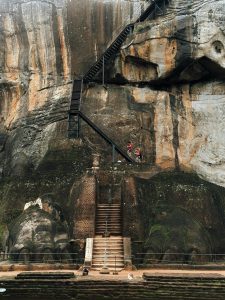
Roughly halfway up the ascent, a spiral metal staircase leads to a sheltered pocket in the rock face. Here, a series of painted figures known as the Sigiriya Damsels survive from the 5th century. Originally, over 500 figures covered the rock face. Today, 21 remain visible.
Photography is strictly forbidden in this section, a rule enforced to protect the pigments from flash damage. Put the camera away. Spend the time actually looking at them. The quality of the painting, the expression on each figure, and the sheer implausibility of their survival for over 1,500 years are genuinely moving when you give them your full attention.
The Mirror Wall
Just past the frescoes, a polished plaster wall lines the pathway. In Kashyapa’s time, it was finished to a mirror like sheen that reflected the paintings above. Today it is covered in inscriptions left by visitors across more than a thousand years of recorded graffiti, some dating back to the 8th century. It represents one of the oldest collections of written Sinhala in existence.
The Lion’s Paws
Near the top, two enormous lion paws carved directly from the rock flank the final staircase. These are all that remain of the original lion shaped gateway that once gave Sigiriya its name. The full lion head and body have eroded away over the centuries. What remains is still extraordinary.
The Summit Palace Ruins
At the top, the ruins of Kashyapa’s palace spread across the flat summit. A swimming pool carved from the rock still holds water. The foundations of the throne room, the royal bedchambers, and the audience hall are visible with the help of interpretive signage.
The views from the summit reach across flat jungle to distant reservoirs, villages, and hills in every direction. On a clear morning, the landscape stretches as far as the eye can follow.
How Hard Is the Climb?
This is the question most people ask before they visit. The honest answer is: moderately challenging, but absolutely manageable for most people.
The full ascent involves approximately 1,200 steps and takes between 1.5 and 2 hours at a comfortable pace, depending on fitness. The path is well maintained throughout. There are handrails on the steeper sections. Rest platforms appear regularly for those who need a pause.
The most physically demanding section is the final push past the Lion’s Paws to the summit. Narrow metal staircases attach to the rock face and feel exposed. People with a fear of heights sometimes find this section difficult. However, the staircases are secure and thousands of people complete the climb every day.
Start early. The heat at midday makes the climb significantly harder. Starting at 6 AM or 7 AM keeps temperatures manageable and puts you ahead of the main tourist crowds.
Best Time to Visit Sigiriya Rock Fortress
- By season: December to April is the optimal window. Dry weather means better climbing conditions, clearer summit views, and lower risk of slippery steps. March offers particularly clear skies. The monsoon season from May to September brings rain that makes the rock slippery and frequently covers the summit in low cloud.
- By time of day: Arrive as early as possible. The ticket office opens at 5:30 AM. An early start gives you cooler temperatures for the climb, better light for photography in the gardens, and significantly fewer people on the steps. By 10 AM, the site is genuinely crowded and the heat becomes a real factor.
Avoid: Midday visits in the dry season. The exposed rock reflects heat intensely and the climb becomes unpleasant. The experience at 7 AM and at noon are completely different.
How to Get to Sigiriya Rock Fortress
- From Colombo: The drive covers approximately 175 kilo meters via the A6 highway and takes around 4 hours by private vehicle. A direct private car or taxi is the most comfortable option. Alternatively, take a train or bus to Dambulla, then connect by local bus or tuk tuk for the final 30 minute leg to Sigiriya.
- From Kandy: Approximately 90 kilo meters by road, taking around 2.5 hours. A private car or bus to Dambulla followed by a tuk tuk works well.
- From Dambulla: Frequent local buses and tuk tuks cover the 17 kilo meters journey. Tuk tuks typically charge around 800 to 1,000 LKR one way.
- From Habarana: Sigiriya sits just 15 kilo meters away. Habarana is one of the most popular base towns for visiting Sigiriya and Pidurangala, with good accommodation options at all price points.
Do You Need a Guide?
A guide is not mandatory, but it adds genuine value at Sigiriya Rock Fortress. The history behind what you are seeing, the stories of Kashyapa’s reign, the engineering explanations for the water gardens, and the cultural context of the frescoes all make the site significantly richer when explained well.
Licensed guides are available at the entrance and charge around USD 15 to 25 for a full tour. Alternatively, the on site museum, included in the entrance fee, provides 3D models and photographic documentation from archaeological excavations. Visit it before the climb for useful context.
Where to Stay Near Sigiriya
In Sigiriya village: Staying directly in Sigiriya village is the best option for an early morning start. Small guesthouses and homestays fill the area. Prices are lower than in larger towns, and the local atmosphere adds genuine character to the experience.
Habarana: A popular base 15 kilo meters away. Good mid range and boutique hotel options, easy connections to Sigiriya, Polonnaruwa, and Minneriya National Park.
Luxury options: The Water Garden Sigiriya, Aliya Resort and Spa, and Jetwing Vil Uyana all offer high end experiences within easy reach of the site.
Nearby Attractions Worth Combining
- Pidurangala Rock sits just 2 kilo meters away. The hike to the summit offers the best available view of Sigiriya from the outside. The entrance fee is USD 3.50 compared to Sigiriya’s USD 36. Many experienced travelers do Pidurangala at sunrise and Sigiriya in the afternoon.
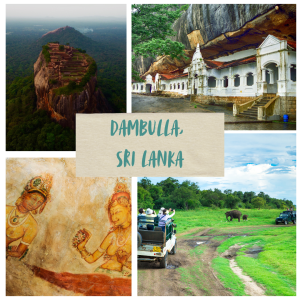
- Dambulla Cave Temple is 17 kilo meters away. Five interconnected caves hold some of Sri Lanka’s finest Buddhist cave murals and an extraordinary collection of ancient statues. It is a UNESCO World Heritage Site and a worthwhile half day stop.
- Minneriya National Park is 30 kilo meters away. Between June and October, the famous Elephant Gathering takes place at the Minneriya reservoir, one of the largest concentrations of wild Asian elephants on earth.
- Polonnaruwa is 50 kilo meters away. Sri Lanka’s ancient medieval capital contains extensive ruins, temples, and stone sculptures. It represents the next major stop on the Cultural Triangle circuit.
Practical Tips Before You Go
- Wear the right shoes. The steps at Sigiriya Rock Fortress are uneven and can be slippery, particularly in the morning dew or after rain. Proper trainers or hiking shoes make a real difference. Sandals are manageable in the gardens but inadequate for the upper sections.
- Bring more water than you think you need. Water refill stations sit near the entrance. Fill up before you start and carry at least 1.5 liters per person. Dehydration on a hot day during the climb is genuinely unpleasant.
- Protect yourself from the sun. Sunscreen, a hat, and light breathable clothing are essential. The final section of the climb is fully exposed with no shade.
- Leave early for photography. The water gardens photograph best in the soft morning light before the sun rises fully. The frescoes are in shade for most of the morning. Summit shots look best with early light on the plains below.
- Book your ticket online. Queue times at the ticket office can run 30 to 45 minutes during peak season. Booking through the Central Cultural Fund website before you arrive saves that time and puts you on the rock sooner.
FAQ: Sigiriya Rock Fortress
- How much does it cost to visit Sigiriya Rock Fortress? Foreign adult visitors pay USD 36 per person. Children aged 6 to 12 pay USD 20. SAARC country visitors pay USD 20 for adults. Local Sri Lankan adults pay LKR 120.
- How long does it take to climb Sigiriya? The ascent takes 1.5 to 2 hours at a comfortable pace. Allow at least 3 to 4 hours total for the full site including the water gardens, museum, and summit.
- Is Sigiriya Rock Fortress difficult to climb? The climb is moderately challenging. There are approximately 1,200 steps. Most reasonably fit adults complete it without significant difficulty. The final staircases feel exposed and can be challenging for people with a strong fear of heights.
- What is the best time to visit Sigiriya? December to April is the best season. Early morning visits between 6 AM and 9 AM offer cooler temperatures and smaller crowds.
- Can you buy Sigiriya tickets online? Yes. Tickets are available through the Sri Lanka Government Central Cultural Fund website. Online purchase avoids queuing at the gate.
- Is photography allowed everywhere at Sigiriya? Photography is permitted throughout the site except at the frescoes section. No flash photography is allowed anywhere in enclosed or cave areas.
- Should I visit Sigiriya or Pidurangala? The ideal answer is both. Visit Pidurangala at sunrise for the best external view of Sigiriya. Then visit Sigiriya Rock Fortress itself for the historical and archaeological experience.
Entrance fees, opening hours, and visitor regulations are subject to change. Always verify current details with the Central Cultural Fund or your accommodation before visiting.



Leave a Reply