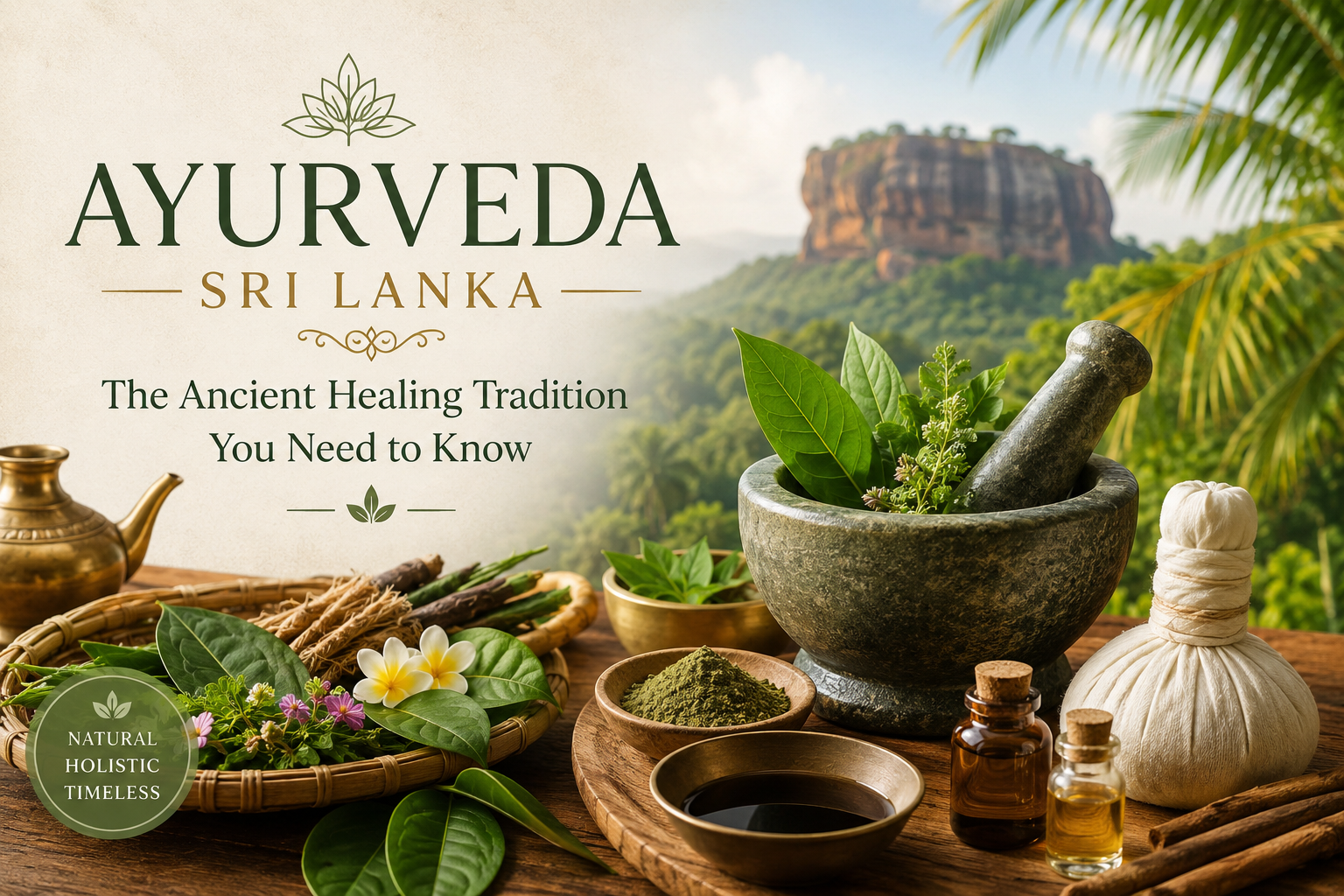
You are sitting in a quiet garden somewhere in Kandy. A traditional healer reads your pulse. Not your heart rate. Your pulse. He closes his eyes, listens, and within minutes tells you things about your digestion, your sleep patterns, and your stress levels that feel uncomfortably accurate. No blood tests. No questionnaire. Just a hand, a wrist, and 5,000 years of accumulated knowledge.
This is what Ayurveda in Sri Lanka actually looks like when you experience it authentically. Not a spa treatment dressed up in wellness branding, but a living medical tradition that predates written history. The island calls it Hela Wedakama. And it is one of the most remarkable healing systems anywhere in the world.
Here is everything you need to know about it.
Hela Wedakama: Sri Lanka’s Own Healing System
Most people assume that Sri Lankan Ayurveda is simply Indian Ayurveda practiced on a different island. That assumption is incorrect, and practitioners here will tell you so directly.
Hela Wedakama is Sri Lanka’s indigenous medical system. It predates the arrival of Indian Ayurveda on the island and developed entirely from the knowledge of the Hela tribes, the original inhabitants of Sri Lanka. The tradition blends Desheeya Chikitsa (the island’s own medicine), elements of Indian Ayurveda, and ancient Siddha and Unani influences absorbed over centuries of cultural exchange.
What makes it distinct is its deep reliance on Sri Lanka’s own biodiversity. Over 1,100 native medicinal plants, many of them endemic to the island, form the foundation of Hela Wedakama remedies. These plants grow in conditions found nowhere else on earth, producing compounds with properties that modern pharmacology is only beginning to document seriously.
The core philosophy is not complicated. Rather than treating symptoms in isolation, Hela Wedakama addresses the root cause of illness by restoring harmony between body, mind, and spirit. As practitioners put it: the goal is not to silence the problem, but to resolve it completely.
A Healing Tradition 5,000 Years in the Making
King Ravana and the Origins of Hela Veda
According to Sri Lankan tradition, the practice of Hela Wedakama traces back over 5,000 years to the era of King Ravana, one of the island’s most legendary figures. Ravana is credited with an extraordinary knowledge of natural medicine, using what is known as Panchangaya, the five parts of medicinal plants: flowers, fruit, leaves, bark, and root, to treat illness.
Many genuine traditional practitioners still begin their treatments by paying homage to King Ravana, seeking his blessing before addressing a patient. Whether historical or mythological, the figure of Ravana remains inseparable from the identity of Hela Wedakama.
The First Hospitals in the World
Sri Lanka carries a remarkable medical claim that is often overlooked internationally. Ancient inscriptions on rock surfaces and the ruins of cities like Anuradhapura, Polonnaruwa, Medirigiriya, and Mihintale suggest that Sri Lanka established organized hospital systems long before most other civilizations.
Some historians believe Sri Lanka was the first country in the world to build dedicated hospitals, including facilities capable of performing surgeries, even on animals. The ruins at Mihintale still attract visitors today, and the sight of ancient surgical wards carved from stone makes the claim feel entirely plausible.
King Buddhadasa: The Physician King
Of all the royal figures associated with Ayurveda in Sri Lanka, King Buddhadasa stands apart. Reigning in the 4th century AD, he was simultaneously a surgeon, a veterinarian, and a physician. He established sanatoriums along major roads to provide free healthcare to travelers and composed the medical treatise Sarartha Sangrahaya, a text that Hela Veda practitioners still consult today.
The story most often told about King Buddhadasa involves a poisonous snake writhing in pain on a roadside. The king dismounted his royal elephant, performed surgery on the serpent, and continued his journey. His habit of carrying surgical instruments and medicines in a personal bag while travelling on royal business tells you everything about how seriously he took the healer’s calling.
The famous Sri Lankan saying, “If you cannot be a king, become a healer,” has its roots in this era of royal medical patronage.
The Keepers of Hela Medicine: Veeduras and Puskola Books
Traditional Healers and Their Role
The guardians of Hela Wedakama are known as Veeduras, traditional healers who carry generations of accumulated medical knowledge. Their diagnosis relies on pulse reading, observation, and a deep understanding of the individual’s physical and emotional state. Many Veedura lineages are still practiced within the same families today, passed from parent to child across multiple generations.
Some of these healer family homes have been declared national cultural heritage sites by the Sri Lankan government, reflecting their significance not just medically but culturally.
The Puskola Manuscripts
Hela medical knowledge was preserved on palm leaf manuscripts known as Puskola books. These ancient texts document herbal recipes, treatment protocols, diagnostic methods, and healing techniques accumulated over thousands of years. Palm leaf ages well under the right conditions, and many Puskola manuscripts survive intact, still consulted by practitioners today.
Key ancient texts in the tradition include the Sarartha Samgrahaya, the Vatika Prakaranaya, the Deshiya Chikitsa Samgrahaya, and the Bhaissajjya Manjusa, written by the Reverend Anomadassi Thero in 2 BC. These texts represent one of the most extensive bodies of traditional medical literature in Asia.
What Hela Wedakama Actually Treats
One of the most striking aspects of Sri Lanka’s traditional medicine is the breadth of conditions it addresses. This is not a wellness system restricted to general wellbeing. It is a comprehensive medical tradition with distinct specializations.
Current active branches of Hela Wedakama include:
- Kedum bidum Wedakama covers orthopedics and fracture healing. Traditional healers apply herbal pastes and specific immobilization techniques to accelerate bone repair. Patients with fractures who have combined traditional and modern treatment frequently report positive outcomes.
- Es Wedakama addresses ophthalmology using herbal eye drops and cleansing rituals drawn from ancient practice. The approach focuses on treating the underlying cause of eye conditions rather than managing symptoms.
- Sarpavisha Wedakama covers treatment for snake bites, a branch of genuine medical importance in a tropical country with significant snake diversity.
- Unmada Wedakama addresses mental health and psychiatry, drawing from a tradition deeply connected with Buddhist principles of mindfulness and mental clarity. Ancient texts like the Bisajja Manjusa describe a society where spiritual and physical health were understood as inseparable.
- Gedi Wana Pilika Wedakama covers treatment of abscesses, wounds, and certain cancers using herbal compounds. Some contemporary practitioners report success treating cancers and chronic kidney disease of unknown origin (CKDu), conditions that modern medicine struggles with in rural Sri Lanka.
The Core Treatments of Hela Wedakama
At the heart of Ayurveda Sri Lanka are treatments derived almost entirely from nature. The primary formulations used in Hela Wedakama include:
Svarasa are freshly pressed herbal juices taken internally or applied topically. Kalka are medicinal pastes prepared from ground plant materials. Kasaya are therapeutic herbal teas brewed according to ancient prescriptions. Thaila are healing oils prepared through elaborate cooking processes that sometimes take days to complete.
The cleansing treatment known as Panchakarma sits at the core of deeper therapeutic programs. It involves five sequential procedures designed to detoxify the body, strengthen the immune system, and support the body’s natural healing processes.
Alongside the physical treatments, spiritual practices form an integral part of care. Meditation, mindfulness, and mantra applications are considered inseparable from physical therapy, reflecting the tradition’s understanding that body and mind heal together or not at all.
The Science Behind the Tradition
Hela Wedakama is not simply cultural heritage. Modern scientific research is increasingly validating what traditional practitioners have claimed for centuries.
A well documented example involves the plant Adhatoda vasica, known locally as Adatoda. Hela Wedakama has used this plant for centuries to treat lung disorders and asthma. Modern pharmacology isolated the active compound from Adatoda and synthesized Bromhexine, now found in cough syrups dispensed in pharmacies worldwide. The leaf itself, dried and rolled, was historically smoked as a treatment for asthma.
Research institutions in Sri Lanka and internationally are now actively studying Hela herbs for efficacy, bioavailability, and potential pharmaceutical applications. The findings consistently show that many traditional remedies are not only effective but are better tolerated and produce fewer side effects than synthetic equivalents.
Ayurveda Sri Lanka Today: Hospitals, Education and Integration
A Nationwide Medical Network
Ayurveda Sri Lanka operates through a significant national infrastructure. Currently, more than 8,000 traditional physicians hold registration with the Ayurveda Medical Council of Sri Lanka. These practitioners work across a network of three Ayurveda Teaching Hospitals, four Ayurveda Research Hospitals, 56 Provincial Ayurveda Hospitals, and 208 Ayurveda Central Dispensaries spread across the island.
This is not a fringe alternative to the mainstream healthcare system. It is a formally recognized, government supported parallel medical tradition with its own training institutions, registration bodies, and hospital network.
Education and Academic Training
Formal academic training in traditional medicine in Sri Lanka dates to 1929, when teaching began at what is now the Institute of Indigenous Medicine at the University of Colombo. The institution offers undergraduate and postgraduate programs combining traditional medical knowledge with modern clinical training.
The Siddha Medicine Unit, another branch of Sri Lanka’s traditional medicine heritage, operates from the University of Jaffna following its relocation in 1984. Both institutions train practitioners who can move fluidly between traditional diagnosis and modern medical understanding.
Integration with Modern Healthcare
Sri Lankan hospitals increasingly incorporate Ayurvedic consultations alongside conventional medical treatment. Patients with chronic conditions that respond poorly to Western pharmaceuticals are often referred to Ayurvedic practitioners for complementary care.
The integration is not without tension. Colonial rule under the Dutch, Portuguese, and British actively marginalized indigenous medical practices for centuries, shifting public trust toward Western medicine and interrupting the transmission of traditional knowledge. The recovery of that ground is ongoing and uneven. Reduced government funding in recent years has created pressure on educational institutions and reduced the formal recognition of traditional practitioners in some healthcare settings.
Experiencing Ayurveda Sri Lanka as a Visitor
Tourism has become an important channel for introducing Hela Wedakama to international audiences. Increasingly, visitors come to Sri Lanka specifically seeking authentic traditional medicine experiences, not resort spa treatments, but genuine clinical encounters with registered traditional practitioners.
Authentic experiences range from brief consultations with a Veedura to extended residential treatment programs lasting several weeks. Legitimate Hela Wedakama treatment centers focus on clinical outcomes rather than aesthetics. Ask directly whether the practitioner holds registration with the Ayurveda Medical Council of Sri Lanka before beginning any treatment.
When booking wellness experiences in Sri Lanka, the distinction between a genuine Hela Wedakama treatment and a massage packaged with Ayurvedic branding matters considerably. The former involves proper diagnosis. The latter involves a booking form.
Preserving a Living Tradition
The challenges facing traditional medicine in Sri Lanka are real. Decades of colonial disruption broke the continuity of knowledge transmission in many lineages. Reduced government funding has pressured educational institutions. The commercial wellness industry sometimes packages superficial versions of traditional practice in ways that dilute public understanding of the genuine tradition.
Against these challenges, preservation efforts have gained genuine momentum. Community workshops, documentary projects, and academic research programs are actively working to document undocumented family held knowledge before it is lost. The Sri Lankan government’s designation of certain healer family homes as national cultural heritage sites reflects a formal commitment to the tradition’s survival.
The Puskola manuscripts that preserve this knowledge have benefited from digitization projects, making ancient texts accessible to researchers and practitioners internationally for the first time.
FAQ: Ayurveda Sri Lanka
- What is the difference between Ayurveda and Hela Wedakama? Ayurveda refers broadly to the ancient Indian science of life. Hela Wedakama is Sri Lanka’s indigenous medical system, which predates the arrival of Indian Ayurveda on the island. Sri Lankan traditional medicine blends Hela Wedakama, Indian Ayurveda, and Siddha and Unani influences, creating a distinct tradition tied to the island’s own biodiversity and cultural heritage.
- Is Ayurveda treatment in Sri Lanka safe? Treatment from registered practitioners who hold certification from the Ayurveda Medical Council of Sri Lanka is considered safe and well regulated. Always verify a practitioner’s registration before beginning treatment. Avoid unverified practitioners offering treatments without proper clinical assessment.
- Where can I experience authentic Ayurveda in Sri Lanka? Registered Ayurveda Teaching Hospitals, Provincial Ayurveda Hospitals, and reputable traditional wellness centers across the island offer authentic treatment. Cities including Colombo, Kandy, and Galle have the highest concentration of registered practitioners.
- How long does an Ayurveda treatment program take? This depends entirely on the condition being treated and the treatment approach. A consultation can take one to two hours. Deeper Panchakarma cleansing programs typically run for a minimum of seven days and often much longer for chronic conditions.
- Can Ayurveda treat serious illnesses? Traditional practitioners in Sri Lanka report success treating conditions including fractures, eye disorders, skin conditions, and some chronic diseases. Some practitioners work with cancer patients and those suffering from chronic kidney disease. Any serious condition should involve consultation with both traditional and conventional medical practitioners.
- Is Ayurveda Sri Lanka regulated by the government? Yes. The Ayurveda Medical Council of Sri Lanka registers and regulates traditional practitioners. The Institute of Indigenous Medicine at the University of Colombo provides formal academic training. The government operates Ayurveda Teaching Hospitals, Research Hospitals, and Provincial Ayurveda Hospitals across the island.
Medical information in this article is for educational purposes only. Always consult a registered medical practitioner before beginning any treatment program.
Leave a Reply